What Inspired Her to Do Art Alma Woodsey Thomas
| Alma Thomas | |
|---|---|
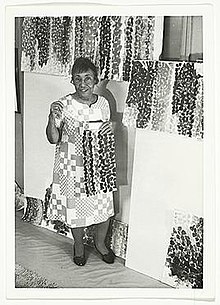 Alma Thomas in her studio, ca. 1968 | |
| Born | Alma Woodsey Thomas (1891-09-22)September 22, 1891 Columbus, Georgia, U.Due south. |
| Died | February 24, 1978(1978-02-24) (aged 86) Washington, D.C. |
| Education | Howard University Columbia University |
| Known for | Painting |
| Notable work | Sky Light; Iris, Tulips, Jonquils and Crocuses; Watusi (Difficult Border); Current of air and Crepe Myrtle Concerto; Air View of a Jump Nursery; Milky way; Flowers at Jefferson Memorial; Untitled (Music Serial); Ruby Rose Sonata; Breeze Rustling Through Fall Flowers; The Eclipse |
| Movement | Expressionism Realism |
| Website | Michael Rosenfeld Gallery |
Alma Woodsey Thomas (September 22, 1891 – Feb 24, 1978) was an African-American creative person and teacher who lived and worked in Washington, D.C., and is now recognized as a major American painter of the 20th century. Thomas is best known for the "exuberant", colorful, abstract paintings that she created subsequently her retirement from a 35-year career didactics art at Washington's Shaw Junior Loftier School.
Thomas, who is frequently considered a member of the Washington Color Schoolhouse of artists simply alternatively classified by some as an Expressionist, earned her teaching degree from University of the District of Columbia (known as Miner Normal Schoolhouse at the time) and was the first graduate of Howard University's Art department, and maintained connections to that university through her life. She achieved success as an African-American female artist despite the segregation and prejudice of her time.
Thomas's reputation has continued to grow since her decease. Her paintings are displayed in notable museums and collections, and they have been the subject of several books and solo museum exhibitions. In 2021, a museum sold Thomas'southward painting Alma's Flower Garden in a private transaction for $2.8 million.
Life and work [edit]
Childhood, pedagogy, and early teaching positions [edit]
Alma Thomas was built-in on September 22, 1891, in Columbus, Georgia, as the oldest of iv daughters, to John Harris Thomas, a businessman, and Amelia Cantey Thomas, a dress designer.[ane] : 16 Her female parent and aunts, she subsequently wrote, were teachers and Tuskeegee Establish graduates.[ii] : iii She was creative as a child, although her serious artistic career began much afterward in life. While growing up, Thomas displayed her artistic capabilities, and enjoyed making small pieces of artwork such as puppets, sculptures, and plates, mainly out of dirt from the river behind her childhood dwelling. [3] Despite a growing involvement in the arts, Thomas was "not allowed" to go into art museums as a child.[4] She was provided with music lessons, every bit her mother played the violin.[2] : three

Alma Thomas's childhood home in Columbus, Georgia
In 1907, when Thomas was sixteen, the family moved to the Logan Circle neighborhood of Washington, D.C., to escape racial violence in Georgia and to seek the benefits of the public school system of Washington.[5] Her parents made this motion despite that the family "kind of came down a fleck," socially and economically, in leaving their upper-middle form life in Georgia.[6] Describing the reason for the family unit move, she later wrote, "When I finished grade school in Columbus, at that place was nowhere that I could continue my educational activity, so my parents decided to motility the family to Washington."[2] : 3 Other writers have pointed to the Atlanta race riots and racial massacre of 1906 as amid the reasons her family left Georgia.[1] : 18 As another instance of the racial violence that her family faced in Georgia, Alma's father had an encounter with a lynch mob shortly earlier Alma was born, and her family unit attributed her poor hearing to the fright from that incident.[seven] Although still segregated, the nation's capital was known to offer more opportunities for African-Americans than most other cities.[8] Every bit she wrote in the 1970s, "At least Washington's libraries were open to Negroes, whereas Columbus excluded Negroes from its but library."[2] : 3

African American Heritage Trail marker, Alma Thomas Business firm, 1530 15th Street, NW, Washington DC
In Washington, Thomas attended Armstrong Technical High School, where she took her kickoff art classes.[1] : xix Virtually them, she said "When I entered the fine art room, it was like inbound heaven. . . . The Armstrong Loftier Schoolhouse laid the foundation for my life."[vii] In high school, she excelled at math and science, and architecture specifically interested her.[3] A miniature schoolhouse that she made from paper-thin using techniques learned in her architecture studies at Armstrong was exhibited at the Smithsonian in 1912.[7] Although she expressed an interest in condign an architect, it was unusual for women to work in this profession and this express her prospects.
After graduating from high school in 1911, she studied kindergarten didactics at Miner Normal School (now known every bit University of the District of Columbia), earning her teaching credentials in 1913.[i] : 19 In 1914, she obtained a didactics position in the Princess Anne schools on the Eastern Shore of Maryland, where she taught for four months.[1] : 19 In 1915, she started teaching kindergarten at the Thomas Garrett Settlement Firm in Wilmington, Delaware, staying there until 1921.[1] : 19
Thomas entered Howard University in 1921, at age thirty, entering every bit a inferior because of her previous teacher grooming. She started as a dwelling economics student, planning to specialize in costume design, just to switch to fine fine art subsequently studying nether art department founder James V. Herring.[i] : nineteen-twenty [ii] : 27 Her creative focus at Howard was on sculpture; the paintings she produced during her college education were described by Romare Bearden and Henry Henderson as "academic and undistinguished."[9] : 447 She earned her Bachelors of Science in Fine Arts in 1924 from Howard, becoming the first graduate from the University'due south Fine Arts program, and also "possibly the showtime African-American adult female" to earn a bachelors degree in art—or the starting time American woman of any racial background, as the artist Keith Anthony Morrison wrote that "it was said [in 1924] that she was the first woman in America e'er to gain a bachelor's caste in fine art."[1] : 21 [10]
Post-higher career [edit]
In 1924, Thomas began teaching fine art at Shaw Junior High School, a Blackness schoolhouse in the and then-segregated public schools of Washington, D.C., where she worked until her retirement in 1960; she wrote, "I was in that location for thirty-v years and occupied the aforementioned classroom."[two] : 13 [note one] She taught alongside fellow artist Malkia Roberts.[i] : 43 While at Shaw Junior Loftier, she started a community arts program that encouraged pupil appreciation of fine art. The program supported marionette performances and the distribution of student designed holiday cards which were given to soldiers at the Tuskegee Veterans Administration Medical Center. Also, according to her reminiscences, "At Shaw, I organized the first art gallery in the D.C. public schools in 1938, securing paintings by outstanding Negro artists from the Howard Gallery of Art."[1] : 23 [2] : 4
The three and a half decades of Thomas'south teaching career, 1924-1960, were described by Thurlow Tibbs, the D.C. African-American art dealer (and grandson of Thomas's friend Lillian Evans, the opera vocalist) equally Thomas's "fermenting period;"[1] : 41 during them she absorbed many ideas and influences, and after 1960 from those ideas and influences she would create her own distinctive art. While she taught at Shaw Junior High, Thomas continued to pursue her fine art, her formal and informal education, and activities with the Washington, D.C. art community, the latter oftentimes in ways connected to Howard University.
During this fourth dimension Thomas painted, specially in watercolor; while her fashion in the 1930s was described as nevertheless "quite traditional" and naturalistic, she has been called a "brilliant watercolorist."[9] : 449, 450 Over summers, she would travel to New York City to visit art museums, including the Metropolitan Museum of Art, and galleries.[9] : 448
During the summers of 1930 through 1934, she attended Teachers College of Columbia University, earning her Masters in Art Education in 1934; her studies focused on sculpture, and she wrote her thesis on the use of marionettes.[1] : 11,23 [7] [three] [9] : 447
In the summertime of 1935, she further studied marionettes in New York City with the German-American puppeteer Tony Sarg, known equally the father of modern puppetry in America.[1] : 23
In 1936, she founded an arrangement, called the School Arts League Project, to bring art opportunities to children.[1] : 22 [3] [11] [ii] : 4
In 1943, Thomas helped James W. Herring, her onetime professor at Howard, and Alonzo J. Aden found the Barnett-Aden Gallery, the first successful Black-owned private art gallery in the United States.[12] : two She served as the gallery'southward Vice President. Thomas's association with the Barnett-Aden Gallery has been described as "critical to" and, according to curator Adelyn Dohme Breeskin, the "pivotal" development in, her evolution equally a professional artist." It put her into contact with leading contemporary national artists, which "heightened her awareness of fine art trends and directions," and it provided exposure to local artists which "both challenged and inspired her."[1] : 24 [nine] : 448 [13]
In the 1940s Thomas also joined Lois Mailou Jones's creative person community, "The Trivial Paris Grouping (or "Niggling Paris Studio," or "Little Paris Studio group"). This group of Blackness Washington artists was founded by Jones and Céline Marie Tabary, both artists and members of the Howard Academy art kinesthesia (Jones from 1930 to 1977, and Tabary commencement in 1945). The appointment of the grouping's founding is described variously as during the German occupation of Paris (i.e., 1940-1944),[14] "the late 1940s,"[i] : 24 1945,[ citation needed ] 1946,[xv] or 1948.[16] Information technology met either weekly[17] [xviii] or twice per week,[1] : 24 [14] at Jones' studio, the "Little Paris studio," in her dwelling at 1220 Quincy Street NE, in Washington'southward Brookland neighborhood.[18] It existed for five years.[1] : 24 It offered developing artists an opportunity to paint from the model,[19] to amend their techniques -- "developing skills and styles,"[17] and "to hone their skills and commutation critiques"[xiv]—as well every bit a salon, or discussion forum—to "talk about the latest developments in modern art, particularly as it was centered in Paris."[xix] Other members of the grouping in add-on to Jones and Tabary included Delilah Pierce and Thomas, likewise as Bruce Brownish, Ruth Brownish, Richard Dempsey, Barbara Linger, Don Roberts, Desdemona Wade, Frank West, and Elizabeth Williamson.[20] [fourteen] A photo, from Thomas'south archives, of a 1948 gathering of the group shows thirteen artists and a male person model.[20] [21]
In 1958, Thomas visited art centers in Western Europe with Temple University students in an extensive bout arranged by that university's Tyler School of Art.[1] : 25 [9] : 450
Her interest with the Piddling Paris Group is said to have inspired Thomas to seek farther academic grooming at American University. One source states that in the early 1950s, "the A.U. art department was regarded in many quarters as 'the' avant-garde art department in the nation."[22] Appropriately, in 1950, at the age of 59, she began a decade of studies at that university, taking nighttime and weekend classes, studying Art History[ citation needed ] and painting.[9] : 449 [23] At American University she studied painting with Robert Franklin Gates and Ben "Joe" Summerford. Simply Jacob Kainen was her most influential teacher in that location, and would become a close friend for the remainder of her lifetime. When Tomas studied with Kainin in fall 1957, he considered her as a fellow artist rather than as a student.[1] : 11 Kainen had met Thomas in 1934, at the Barnet-Aden Gallery, and in 1957, he agreed to take over educational activity an intensive year-long A.U. grade for six selected top painting students, including Thomas, but the administration immune 32 students, many of them beginners, to take the course and Kainen quit in frustration later on 1 term.[one] : 30
When Thomas began her advanced studies at American University in 1950, she was still a figurative painter. During the 1950s her style evolved in several major shifts, from figurative painting to cubism and then to abstract expressionism, with "monumental," dark paintings largely in blue and brownish tones, to beginning to comprehend the bright colors that she would later use in her signature manner.[1] : 25, 30-31
Artistic career [edit]
"Creative art is for all time and is therefore independent of time. It is of all ages, of every land, and if by this nosotros mean the creative spirit in human which produces a picture or a statue is common to the whole civilized world, independent of historic period, race and nationality; the statement may stand unchallenged."
-Alma Thomas, 1970[24]
Thomas would non go a full-time, professional artist until she was 68 or 69 years old, in 1960, when she retired from teaching.
Within twelve years after her starting time class at American, she began creating Color Field paintings, inspired past the work of the New York School and Abstract Expressionism.[24]
Thomas was known to work in her dwelling house studio (a pocket-sized living room), creating her paintings by "propping the sheet on her lap and balancing it against the sofa."[three] She worked out of the kitchen in her house, creating works similar Watusi (Difficult Edge) (1963), a manipulation of the Matisse cutout The Snail,[25] in which Thomas shifted shapes around and inverse the colors that Matisse used, and named it subsequently a Chubby Checker song.[5]
In contrast with about other members of the Washington Color Schoolhouse, she did not use masking tape to outline the shapes in her paintings.[9] : 451 Her technique involved drawing faint pencil lines across the sail to create shapes and patterns, and filling in the canvas with paint afterwards. Her pencil lines are obvious in many of her finished pieces, equally Thomas did not erase them.[3]
Thomas'southward post-retirement artwork had a notable focus on color theory.[three] Her work at the fourth dimension resonated with that of Vasily Kandinsky (who was interested in the emotional capabilities of color) and of the Washington Color Field Painters, "something that endeared her to critics . . . just also raised questions most her 'blackness' at a time when younger African-American artists were producing works of racial protest."[26] She stated, "The utilise of colour in my paintings is of paramount importance to me. Through color I have sought to concentrate on beauty and happiness in my painting rather than on man'due south inhumanity to human."[two] : xi Speaking once more about her apply of color she said: "Color is life, and low-cal is the mother of color."[27]
In 1963, she walked in the March on Washington with her friend, the opera singer Lillian Evans.[28] Although Thomas was largely an apolitical artist,[29] she portrayed the 1963 effect in a 1964 painting.[30] A detail from that painting became a 2005 U.S. stamp commemorating the March on Washington.[31]
Her starting time retrospective exhibit was in 1966 (April 24–May 17) at the Gallery of Fine art at Howard University, curated by fine art historian James A. Porter. It included 34 works from 1959 to 1966. For this exhibition, she created Earth Paintings, a series of nature-inspired abstract works, including Resurrection (1966),[32] which in 2014 would be bought for the White House collection.[33] [34] Thomas and the artist Delilah Pierce, a friend, would drive into the countryside where Thomas would seek inspiration, pulling ideas from the effects of light and atmosphere on rural environments.[ citation needed ]
To meet the challenge posed by the Howard show, according to Romare Bearden and Henry Henderson, her style changed again, in a crucial mode: "Thomas evolved the specific style now recognized every bit her signature - playing color against color and over colour with small, irregular rectangular shapes of dense, ofttimes intense colour."[9] : 450 This exhibition received a supportive review from Helen Hoffman in The Washington Post of May 4, 1966, titled "colorful abstract reflects her spirit".[32]
Inspired past the moon landing in 1969, Alma Thomas began her second major theme of paintings. The series Space, Snoopy and Earth were applying pointillism. She evoked mood by dramatic dissimilarity of color with mosaic style, using nighttime bluish against pale pink and orange colors, depicting an abstraction and accidental dazzler through the utilise of colour. About of the works in these serial have circular, horizontal and vertical patterns. These patterns are able to generate a conceptual feeling of floating. The patterns as well generate energy within the canvass. The dissimilarity of colors creates a powerful colour segregation, and maintain visual energy.[35]

In 1972, at the age of 81, Thomas was the first African-American woman to have a solo exhibition at the Whitney Museum of American Art, and later on the same year a much larger exhibition was likewise held at the Corcoran Gallery of Art.[24] [9] : 452 Thomas denied labels placed upon her as an artist and would not accept any barriers inhibiting her creative process and art career, including her identity as a black adult female.[36] She believed that the most of import thing was for her to continue to create her visions through her own artwork and work in the art world despite racial segregation.[37] Despite this, Thomas was withal discriminated confronting as a black female artist and was critiqued for her abstruse way as opposed to other Black Americans who worked with figuration and symbolism to fight oppression. Her works were featured alongside many other African-American artists in galleries and shows, such as the first Blackness-endemic gallery in the District of Columbia.[36]
Subsequently her show at the Whitney, Thomas'due south fame within the fine arts customs immediately skyrocketed. Her newfound recognition was due in part to Robert Doty'due south song back up of her, as he organized Thomas'southward Whitney testify as part of a series of African-American artist exhibitions, intended to protest their lack of representation.[26] New York critics were impressed with Thomas's modern style, especially given the fact that she was a most fourscore-yr-old woman at the time of her national debut.[26] The New York Times reviewed her exhibit four times, calling her paintings "expert abstractions, tachiste in fashion, faultless in their handling of colour."[38] Many white critics complimented her as "the Signac of current color painters" and as "gifted, ebullient abstractionist". Alma Thomas's philosophy of her own art is that her works are full of energy, and those energies cannot be destroyed or created.[39]
New York art curator and editor Thomas B. Hess bought Thomas's 1972 painting Red Roses Sonata, and in 1976 his family unit'due south foundation gave the piece to the Metropolitan Museum of Art.[ane] : 34 [11] [40] Joshua Taylor, director from 1970 to 1981 of the National Collection of Fine Arts (at present the Smithsonian American Art Museum), also purchased some of her work, and wrote to Thomas in 1975, thanking her for a painting that hung in his living room: "It's similar having Jump well before its appointed date."[41] [42] [43]
Mary Beth Edelson's Some Living American Women Artists / Last Supper (1972) appropriated Leonardo da Vinci'southward The Last Supper, with the heads of notable women artists collaged over the heads of Christ and his apostles; Alma Thomas was among those notable women artists. This prototype, addressing the part of religious and art historical iconography in the subordination of women, became "ane of the nearly iconic images of the feminist fine art movement."[44] [45]
Personal life [edit]
Thomas was, according to all evidence, never married. She told the New York Times in 1977 that she had "never married a human only my art. What man would have ever appreciated what I was upward to?"[46] She wrote, "One time upon a time it was said, don't die having a "Miss" on your tombstone. I experience very proud of having maintain[ed] my Miss. I say that Miss stand[s] for all the Jackasses I missed in life."[2] : 34 She added, "A fine man is a delight, merely for God sake don't get entangled with a Jackass."[2] : 35 She had an agile social life, with many creative person friends.[46] She reportedly "rarely missed" a museum or gallery opening in Washington.[nine] : 447
Thomas lived in the same family firm in Washington, at 1530 15th Street, NW, for virtually her entire life, from 1907 when her family moved from Georgia so she could attend high school until her decease in 1978 (aside from a few years in her 20s when she worked elsewhere). Her younger sister John Maurice Thomas, who was named for their father and had a career as a librarian at Howard University, shared the business firm with her.[2] : 7 )[47] [48] That home, at present known as the Alma Thomas House, was built in about 1875 and is listed on the National Annals of Celebrated Places.[49]
Death and archives [edit]
Alma Thomas died on February 24, 1978, in Howard University Infirmary, post-obit aortal surgery.[47]
Thomas' papers were donated in several periods between 1979 and 2004 to the Archives of American Fine art by J. Maurice Thomas, Alma Thomas' sis.[50]
Artistic style [edit]
Alma Thomas' early on piece of work was representational in manner.[24] As a blackness woman, she focused her work on artistic spirit rather than race or gender.[35] Thomas believed that creativity should be independent of gender or race, creating works with a focus on accidental beauty and the abstraction of color.[39]
After further educational activity at American University and influenced by James V. Herring and Lois Mailou Jones, her work became more than abstract.[8] Toward the end of her life, her style moved "to a color-filled, impastoed geometric abstraction of tessellated brushstroke patterns."[26] These paintings accept been compared to Byzantine mosaics and the pointillist paintings of Georges-Pierre Seurat.[8] Thomas' style has qualities similar to W African paintings as well as Byzantine mosaics.[51]
Her watercolor and oil paintings incorporated the utilise of (sometimes overlapping) colorful rectangles. She continued to use this technique, in works which explored colors found in trees, flowers, gardens, and other natural imagery.[3] Her painting Evening Glow was inspired in part by Thomas'due south involvement in the colors of natural globe: "The holly tree exterior her living room intrigued Thomas with designs formed by its leaves against the window panes, and with patterns of light and shade cast on the flooring and walls inside her home."[3] She chosen her paintings 'Alma's Stripes,' as the overlapping shapes of paint created elongated rectangles. After works were inspired by space exploration and the cosmos. The title of her 1972 painting, 'Mars Grit,' alluded to news stories of a dust storm on Mars.[2] : 33 .
Later reactions, exhibits, and developments [edit]
Art historian Richard J. Powell wrote in 1997 about the position of Thomas and Sam Gilliam equally the two best known African-American members of the Washington Colour Schoolhouse, "While conversant with the works of fellow Washington Colour School artists (Gene Davis, Morris Louis, and Kenneth Noland), they also addressed, through rhythmic and high key color abstruse painting techniques, the social aspirations of Washington D.C.'southward African American middle class." He continued past noting that in the 1960s Thomas "turned her dorsum" on her earlier representational style "that would accept been seen by D.C.'s arts customs equally ideologically conservative," in favor of "an abstract style inspired by horticulture, scientific color theory, and music." Powell described Thomas's 1976 Azeleas Singing and Dancing Rock and Roll Music as "skillfully negotiating the slippery pathways betwixt nature and club," and "recap[ing] the integrationist mood of the times."[52] The Washington Post described her equally "a forcefulness in the Washington Color Schoolhouse".[53]
Writing in 1998, art historian Sharon Patton described Thomas's 1973 Wind and Crepe Myrtle Concerto as "one of the most Minimalist Color-Field paintings always produced by an African-American artist."[24]
Although Thomas did not receive a monograph until 1998 when the Fort Wayne Museum exhibited a retrospective on the artist,[26] the lateness of in-depth scholarly attending is not representative of her legacy and influence on the realm of Visual Arts. Jacob Kainen, her teacher at American Academy in autumn 1957,[ane] : 30 asserts that "Thomas played a key role in the development of abstract painting throughout the mid 20th century." Kainen wrote in the catalog of the Fort Wayne show that he met Thomas in 1943, at an issue at the Barnett-Aden Gallery.[1] : xxx Kainen remembers her at that time as "a small, slim woman whose elegance of dress and manner and unmistakable firmness of character made the matter of her size irrelevant."[1] : 30 In the program of the 1966 Howard University Art Gallery's show "Alma W. Thomas: A Retrospective Exhibition, 1959-1966," Kainen is quoted as describing her as "the Signac of current color painters."[32]
In 2009, 2 paintings by Thomas, including Watusi (Hard Edge),[5] were chosen past First Lady Michelle Obama, White Firm interior designer Michael S. Smith (interior designer), and White House curator William Allman to be exhibited in the White Firm during the Obama presidency.[54] Watusi (Difficult Edge) was somewhen removed from the White Business firm due to concerns about the slice fitting into the space in Michelle Obama'southward East Wing part.[55] Sky Light, on loan from the Hirshhorn Museum and Sculpture Garden, hung in the Obama family unit private quarters.[25]
In 2015, another of her paintings, Resurrection (1966), was prominently hung in the Old Family unit Dining Room of the White Business firm, having been caused for the White House collection in 2014 with $290,000 in funding from the White House Historical Clan.[34] [56] It was "the first artwork by an African-American woman to hang in the public spaces of the White House and enter the permanent drove."[34] The pick of Thomas for the White Business firm drove was described every bit an ideal symbol for the Obama administration past The New York Times art critic Holland Cotter. Cotter described Thomas' work as "forward-looking without being radical; postal service-racial only also race-conscious."[57]
In 2016, the exhibition Alma Thomas, described in promotional materials as "the first comprehensive look at the artist's work in almost twenty years," and equally presenting "a broad range of evolution of Thomas'due south work from the belatedly 1950s to her expiry in 1978," was organized by The Frances Young Tang Education Museum and Fine art Gallery at Skidmore College and The Studio Museum in Harlem.[58] This exhibition was curated by Ian Drupe, Dayton Manager of the Tang Museum and Lauren Haynes, Associate Curator, Permanent Drove at the Studio Museum in Harlem and supported by the Friends of the Tang.[58] The exhibit'due south promotional material noted that "Thomas'southward patterned compositions, energetic brushwork and delivery to color created a singular and innovative torso of piece of work." They also noted that information technology "includes rarely exhibited watercolors and early on experiments." This exhibition was divided into four sections: Move to Abstraction; Earth, Space, and Late Work.[58]
The Wall Street Journal described her in 2016 as a previously "underappreciated artist" who is more than recently recognized for her "exuberant" works, noteworthy for their design, rhythm and color.[59]
In 2019, Thomas'south 1970 painting A Fantastic Sunset was auctioned at a Christie's sale.[threescore] It sold for $2.655 million.[61]
In 2021, a new record price was ready for Thomas's work when Alma's Flower Garden, painted in approximately 1968-1970, was deaccessioned by the Greenville County Museum of Art, which sold it in a private sale to an unidentified purchaser for $two.8 million. The museum had bought the painting in 2008 for $135,000.[62] [63]
An exhibition of her art entitled "Alma Westward. Thomas: Everything is Cute," co-organized by the Chrysler Museum of Art in Norfolk, Virginia and the Columbus Museum in Columbus, Georgia, opened on July ix, 2021, at the Chrysler Museum. Information technology is scheduled to run at that place to October 3, 2021, post-obit which it volition run at the Phillips Drove in Washington, D.C., in fall 2021, the Frist Art Museum in Nashville in leap 2022, and the Columbus Museum in summer 2022.[64] [65]
Notable exhibitions [edit]
- Watercolors past Alma Thomas, 1960, Dupont Theatre Art Gallery[66]
- Alma Thomas: A Retrospective Exhibition (1959-1966), 1966, Howard University Gallery of Fine art[66]
- Alma Thomas: Contempo Paintings, 1968, Franz Bader Gallery[66]
- Recent Paintings by Alma W. Thomas: Earth and Space Serial (1961–1971), 1971, Carl Van Vechten Gallery, Fisk Academy[66]
- Alma Due west. Thomas, 1972, Whitney Museum of American Art[66] [67]
- Alma Westward. Thomas: Retrospective Exhibition, 1972, Corcoran Gallery of Art[66]
- Alma W. Thomas: Paintings, 1973, Martha Jackson Gallery[66]
- Alma W. Thomas: Recent Paintings, 1975, Howard University Gallery of Fine art[67]
- Alma West. Thomas: Recent Paintings, 1976, H.C. Taylor Art Gallery, North Carolina Agricultural and Technical Land University[66]
- A Life in Art: Alma Thomas, 1891-1978, 1981, National Museum of American Art, Smithsonian Institution[66]
- Alma Due west. Thomas: A Retrospective of the Paintings, 1998, Fort Wayne Museum of Art, Tampa Museum of Art, New Jersey Land Museum, Anacostia Community Museum, Smithsonian Institution, and The Columbus Museum[66]
- Alma Thomas: Phantasmagoria, Major Paintings from the 1970s, 2001, Michael Rosenfeld Gallery, and Women'south Museum: An Institution for the Future[66]
- A Proud Continuum: Eight Decades of Art at Howard University, 2005, Howard University[53]
- Color Balance: Paintings by Felrath Hines and Alma Thomas, 2010, Nasher Museum of Art[68]
- Alma Thomas, 2016, The Frances Young Tang Teaching Museum and Art Gallery at Skidmore College,[66] and The Studio Museum in Harlem[69]
- Alma Thomas: Resurrection Exhibition, 2019, Mnuchin Gallery [70]
- Alma West. Thomas: Everything is Beautiful, 2021, Chrysler Museum of Art[64]
Notable collections [edit]
- Air View of a Bound Plant nursery, 1966;[71]Columbus Museum[72]
- Breeze Rustling Through Autumn Flowers, 1968;[73]Phillips Collection[74]
- Earth Sermon - Dazzler, Love and Peace, 1971;[75] Hirshhorn Museum and Sculpture Garden[76]
- Evening Glow, 1972;[77] Baltimore Museum of Art[78]
- Peppery Dusk, 1973; Museum of Modern Art[79]
- Hydrangeas Spring Song, 1976;[eighty]Philadelphia Museum of Art[81]
- Iris, Tulips, Jonquils and Crocuses, 1969;[82] National Museum of Women in the Arts[83]
- Lunar Surface, 1970; American University Fine art Gallery[84]
- Nature'due south Ruby Impressions, 1968 [85]George Washington University, Luther W. Brady Art Gallery
- Mars Grit, 1972;[86]Whitney Museum of American Art
- Pansies in Washington, 1969;[87] National Gallery of Art (Corcoran Collection)
- Red Temper, 1972; Tougaloo College Art Collections[88]
- Red Azaleas Singing and Dancing Rock and Curl Music, 1976;[89] Smithsonian American Art Museum
- Ruby Roses Sonata, 1972; The Metropolitan Museum of Fine art[90]
- Resurrection, 1968;[91] White House Historical Association
- Snoopy Early Sun Display, 1970;[92] Smithsonian American Fine art Museum
- Bound Embraces Yellow, 1973;[93] Academy of Iowa, Stanley Museum of Art
- Starry Night and the Astronauts, 1972; Art Establish of Chicago[27]
- Untitled: Music Series, 1978;[94] Smithsonian American Art Museum
- Watusi (Difficult Edge), 1963;[95] Hirshhorn Museum and Sculpture Garden[96]
- White Roses Sing and Sing, 1976;[97] Smithsonian American Art Museum
- Wind and Crêpe Myrtle Concerto, 1973; Smithsonian American Art Museum
- Current of air Sparkling Dew and Dark-green Grass, 1973; Fort Wayne Museum of Art
- Wind, Sunshine and Flowers, 1968;[98] Brooklyn Museum
Notes [edit]
- ^ The number in this judgement is typed as "thirty-8," but in one of the three copies, the "viii" is corrected by hand to "five."
References [edit]
- ^ a b c d e f thou h i j k l m n o p q r s t u five w x y z Thomas, Alma; Fort Wayne Museum of Art (1998). Alma West. Thomas: A Retrospective of the Paintings . Pomegranate. ISBN9780764906862.
- ^ a b c d due east f g h i j k l m Thomas, Alma, "Autobiographical Writings", Alma Thomas papers, circa 1894-2001, Box ii, Binder 7: Autobiographical Writings, circa 1960s-circa 1970s, Smithsonian Archives of American Art, retrieved December 12, 2020 (Cited folio numbers refer to the 36 pages of the online folder, rather than numbers on detail pages in the folder.)
- ^ a b c d e f g h i Scarlet, Schroeder (1997). "Instructional Resources: Four Works by African-American Artists in the Baltimore Museum of Art's Collection". Art Pedagogy. 50 (2): 25–32. doi:10.2307/3193640. ISSN 0004-3125. JSTOR 3193640.
- ^ Sheets, Hilarie (Jan 21, 2016). "Pioneering Painter Alma Thomas Is Making a Comeback thirty Years later Her Final Major Retrospective". Artsy . Retrieved March 6, 2020.
- ^ a b c The netherlands Cotter (October 11, 2009). "White Firm Art: Colors From a World of Blackness and White". The New York Times. Critic'due south Notebook. Retrieved July 6, 2011.
- ^ Valentine, Victoria (April xiv, 2018). "Locating Alma Thomas: Forthcoming Retrospective Will Explore Artist's Creative Life and Hometown Connections". Civilization Type . Retrieved December thirteen, 2020.
- ^ a b c d Munro, Eleanor (April 15, 1979). "The late Spring fourth dimension of Alma Thomas (interview)". Washington Mail service . Retrieved December 12, 2020.
- ^ a b c "Alma Woodsey Thomas". National Museum of Women in the Arts . Retrieved March 2, 2019.
- ^ a b c d e f g h i j k Bearden, Romare; Henderson, Henry (1993). A History of African-American Artists: From 1792 to the Nowadays. New York: Pantheon Books. ISBN9780394570167.
- ^ Morrison, Keith Anthony. "Art in Washington and Its Afro-American Presence: 1940-1970". keithmorrison.com . Retrieved December 12, 2020.
- ^ a b Simpson, Pamela H.; Kainen, Jacob; Gibson, Ann; Binstock, Jonathan P.; Tsujimoto, Karen; Baas, Jacquelynn (2000). "Alma W. Thomas, A Retrospective of the Paintings". Woman'due south Art Journal. 21 (1): 55–56. doi:10.2307/1358876. JSTOR 1358876.
- ^ Abbot, Janet Gail (2008). The Barnett Aden Gallery: A Domicile for Diversity in a Segregated Metropolis (PDF) (Ph.D.). Pennsylvania State Academy.
- ^ Valentine, Victoria. "Art Upper-case letter: Nearly 500 Gather at National Gallery of Art to Discuss African American Fine art in 20th Century Washington". Culture Type . Retrieved December 8, 2020.
- ^ a b c d "The "Other" Lost Generation of Black American Artists in Paris". Messy Nessy Chic. June four, 2020. Retrieved December 7, 2020.
- ^ "Longtime Home of Artist Alma Thomas For Auction in Washington, D.C., for $2.ii 1000000+". Culture Blazon . Retrieved December 7, 2020.
- ^ Rowell, Charles Henry (2016). "Ii Galleries, Engaging Art, Great Talents, and Challenging Minds: The Howard Academy Gallery of Art, the Little Paris Group, and the Barnett-Aden Gallery". Callaloo. 39 (5): 1163–1167. doi:ten.1353/cal.2016.0150. ISSN 1080-6512. S2CID 165243253. Retrieved Dec 8, 2020.
- ^ a b "Delilah W. Pierce Amid Alma Thomas' Little Paris Group, 1948". Delilah W. Pierce. July 3, 2013. Retrieved December 7, 2020.
- ^ a b Malesky, Robert. "PORTRAITS: Loïs Mailou Jones and the Little Paris Studio". Bygone Brookland . Retrieved December 7, 2020.
- ^ a b Yau, John (August xiv, 2016). "Under No Obligation". Hyperallergic . Retrieved December 7, 2020.
- ^ a b "Petty Paris Group in Lois Jones' studio". Smithsonian Institution . Retrieved December 7, 2020.
- ^ "Little Paris Grouping in Lois Jones' studio, 1948, from the Alma Thomas papers, circa 1894-2001". Archives of American Art, Smithsonian . Retrieved December 7, 2020.
- ^ "Thursday, February 11, 2016". Being But Men, We Walked Into the Trees . Retrieved December 8, 2020.
- ^ "Creative person Spotlight: Alma Thomas". National Museum of Women in the Arts - Broad Strokes Blog. October 14, 2009. Retrieved December 17, 2020.
- ^ a b c d e Patton, 220.
- ^ a b Blake Gopnik (November 5, 2009). "Alma Thomas's "Watusi (Hard Border)" Won't Hang in White House". Washington Mail. Arts & Living. Retrieved July 6, 2011.
- ^ a b c d eastward "Reviewed Works: Alma West. Thomas, a Retrospective of the Paintings". Adult female'south Art Periodical. 21 (1): 55–56. 2000. doi:ten.2307/1358116. ISSN 0270-7993. JSTOR 1358116.
- ^ a b "Starry Night and the Astronauts". The Art Institute of Chicago.
- ^ "Alma Thomas's March on Washington …with 250,000 Others". Athenaeum of American Art. August 9, 2013.
- ^ "The Politics of Infinite: Alma Thomas and Race Relations in 1960's America - ProQuest". search.proquest.com . Retrieved October 21, 2020.
- ^ "ALMA THOMAS (1891 1978) March on Washington". Swann Galleries. Archived from the original on August five, 2016. Retrieved August 31, 2019.
- ^ "Today We Take a Stand Confronting Racism". USPS Stamp of Approval (blog). Apr 27, 2012. Retrieved December 11, 2020.
- ^ a b c "Box 2, Folder 43 | A Finding Assist to the Alma Thomas papers, circa 1894-2001 | Digitized Drove". www.aaa.si.edu . Retrieved February 22, 2020.
- ^ ""Resurrection" by Alma Thomas". WHHA (en-U.s.) . Retrieved February 22, 2020.
- ^ a b c Valentine, Victoria (April 17, 2015). "Alma Thomas is Given Pride of Place at the White Firm". Culture Type . Retrieved August 30, 2019.
- ^ a b "Alma Thomas". Smithsonian American Fine art Museum . Retrieved November 12, 2019.
- ^ a b Ian Drupe, Lauren Haynes. (2016). Alma Thomas. Prestel. ISBN978-3791355719.
- ^ Chiliad Harrisburg, Halley (1966). African-American art : 20th century masterworks, 3 : [exhibition]. New York, NY: Michael Rosenfeld Gallery.
- ^ Mellow, James R. (April 29, 1972). "Expert Abstractions by Alma Thomas". The New York Times. ISSN 0362-4331. Retrieved Apr 29, 2019.
- ^ a b Women artists of color : a bio-critical sourcebook to 20th century artists in the Americas . Farris, Phoebe, 1952-. Westport, Conn.: Greenwood Press. 1999. ISBN0313303746. OCLC 40193578.
{{cite book}}: CS1 maint: others (link) - ^ "Red Roses Sonata". www.metmuseum.org . Retrieved December half-dozen, 2020.
- ^ "Joshua Taylor letter to Alma Thomas, 1975 March iii, from the Alma Thomas papers, circa 1894-2001". world wide web.aaa.si.edu . Retrieved April 4, 2019.
- ^ "Joshua C. Taylor Becomes Director of NCFA". Smithsonian Institution Archives. January ane, 1970. Retrieved December vi, 2020.
- ^ "In Memoriam: Joshua C. Taylor '39". Reed Magazine . Retrieved December half dozen, 2020.
- ^ "Mary Beth Edelson". The Frost Fine art Museum Drawing Projection . Retrieved January 11, 2014.
- ^ "Mary Beth Adelson". Clara - Database of Women Artists. Washington, D.C.: National Museum of Women in the Arts. Archived from the original on January ten, 2014. Retrieved January ten, 2014.
- ^ a b Shirey, David Fifty. (May 4, 1972). "At 77, She's Made Information technology to the Whitney". The New York Times . Retrieved December 12, 2020.
- ^ a b Richard, Paul (February 25, 1978). "Alma Thomas, 86, Dies". Washington Postal service . Retrieved December 12, 2020.
- ^ "Obituaries: John Maurice Thomas". Washington Post. March 25, 2004. Retrieved September four, 2021.
- ^ Valentine, Valerie Fifty. "Longtime Abode of Artist Alma Thomas For Sale in Washington, D.C., for $2.2 Million+". Cultural Type . Retrieved September 4, 2021.
- ^ "Alma Thomas papers, 1894–2000". Finding Assist. Archives of American Art. Retrieved July 6, 2011.
- ^ Henkes, Robert (1993). The art of Blackness American women : works of xx-four artists of the twentieth century. Jefferson, Due north.C: McFarland Publishing. ISBN978-0899508184.
- ^ Powell, Richard J. (1997). Blackness art and culture in the 20th century. New York, N.Y.: Thames & Hudson. p. 128. ISBN0-500-20295-8.
- ^ a b Dawson, Jessica (April 7, 2005). "An Alumni Reunion On the Hilltop". The Washington Mail. p. C05. Retrieved October viii, 2009.
- ^ Vogel, Ballad (October 6, 2009). "A Bold and Mod White Firm". The New York Times. p. A14. Archived from the original on June 16, 2013. Retrieved Oct vii, 2009.
- ^ "Alma Thomas' "Watusi" Gets the White House Kibosh". Nov 5, 2009.
- ^ ""Resurrection" by Alma Thomas". White House Historical Association . Retrieved August 30, 2019.
- ^ Robin Cembalest (2009). "Critics Nix Obamas' Pix Mix". Past Issues. ARTnews. Archived from the original on July 7, 2011. Retrieved July half-dozen, 2011.
- ^ a b c "Alma Thomas". Tang Teaching Museum . Retrieved March 2, 2019.
- ^ Alma Thomas Review, The Wall Street Journal, March 1, 2016.
- ^ Armstrong, Annie (October 24, 2019). "Alma Thomas, a Favored Creative person of the Obamas, Could More Than Double Her Auction Record Next Month at Christie'due south". ARTnews.com . Retrieved August 11, 2020.
- ^ "Alma Thomas (1891-1978), A Fantastic Sunset". www.christies.com . Retrieved December 6, 2020.
- ^ Rosenbaum, Lee (Apr 9, 2021). "Doubting Thomas: Greenville County Museum Sells "Alma'due south Bloom Garden" in a Non-Transparent Transaction". CultureGrrl . Retrieved Apr 21, 2021.
- ^ Mayo, Nikie (March 30, 2021). "$ii.8 meg mystery: Greenville museum sells rare Alma Thomas painting to surreptitious buyer". The Greenville News . Retrieved April 21, 2021.
- ^ a b "Everything is Beautiful: Major Alma W. Thomas Traveling Exhibition Opening at Chrysler Museum of Art in July 2021". Retrieved October 21, 2020.
- ^ "Alma W. Thomas:Everything is Beautiful". Chrysler Museum of Fine art . Retrieved December vi, 2020.
- ^ a b c d e f one thousand h i j k l Alma Thomas. Prestel: The Studio Museum in Harlem, The Frances Young Tang Education Museum and Fine art Gallery, and DelMonico Books. 2016. p. 206. ISBN9783791355719.
- ^ a b Making their mark : women artists move into the mainstream, 1970-85 . Rosen, Randy., Brawer, Catherine Coleman., Cincinnati Art Museum. (1st ed.). New York: Abbeville Press. 1989. ISBN0-89659-958-2. OCLC 18259773.
{{cite volume}}: CS1 maint: others (link) - ^ "Color Balance: Paintings by Felrath Hines and Alma Thomas". Exhibitions. Nasher Museum of Art. 2011. Archived from the original on September 28, 2011. Retrieved July half-dozen, 2011.
- ^ "By Exhibits - Alma Thomas". Studio Museum Harlem . Retrieved March 11, 2017.
- ^ "Alma Thomas - Exhibitions - Mnuchin Gallery". www.mnuchingallery.com.
- ^ "Painting - Air View Of A Spring Nursery".
- ^ Charles T. Butler (2004). "Alma Thomas (1891–1978)". Private Artists. The New Georgia Encyclopedia. Archived from the original on June half dozen, 2011. Retrieved July 6, 2011.
- ^ "Breeze Rustling Through Fall Flowers | The Phillips Collection". www.phillipscollection.org.
- ^ "Breeze Rustling Through Fall Flowers". American Art. Phillips Museum. Archived from the original on March iv, 2016. Retrieved July half-dozen, 2011.
- ^ "Globe Sermon - Beauty, Love And Peace".
- ^ "Earth Sermon - Beauty, Beloved and Peace". Hirshhorn Museum and Sculpture Garden | Smithsonian . Retrieved December 12, 2020.
- ^ "The Baltimore Museum of Art". collection.artbma.org.
- ^ "The Baltimore Museum of Art". collection.artbma.org . Retrieved February 13, 2016.
- ^ "Alma Woodsey Thomas. Fiery Sunset. 1973 | MoMA". The Museum of Mod Fine art.
- ^ "Philadelphia Museum of Fine art - Collections Object : Hydrangeas Jump Vocal". www.philamuseum.org.
- ^ "Hydrangeas Leap Song", Philadelphia Museum of Art. Retrieved October 17, 2018.
- ^ "Iris, Tulips, Jonquils, and Crocuses | Artwork".
- ^ "Iris, Tulips, Jonquils and Crocuses". Permanent Collection. National Museum of Women in the Arts. 2011. Archived from the original on June 24, 2011. Retrieved January 10, 2017.
- ^ "American University Museum at the Katzen Arts Center". American Academy . Retrieved Dec 12, 2020.
- ^ "Nature's Cherry Impressions". www.facebook.com.
- ^ "Alma Thomas | Mars Grit". whitney.org.
- ^ "In Depth: "Pansies in Washington" past Alma Thomas". www.nga.gov.
- ^ "Art and Ceremonious Rights: The Mississippi Museum of Art and Tougaloo College Art and Civil Rights Initiative, 2017–2020" (PDF). p. 22. Retrieved December 12, 2020.
- ^ "Cherry-red Azaleas Singing and Dancing Rock and Ringlet Music | Smithsonian American Art Museum". americanart.si.edu.
- ^ "The Metropolitan Museum of Art". metmuseum.org/art/collection . Retrieved January 29, 2017.
- ^ ""Resurrection" by Alma Thomas". WHHA (en-United states).
- ^ "Snoopy--Early Sun Display on Earth | Smithsonian American Art Museum". americanart.si.edu.
- ^ "Jump Embraces Yellowish | The Academy of Iowa Libraries". digital.lib.uiowa.edu.
- ^ "Untitled (Music Serial) | Smithsonian American Fine art Museum". americanart.si.edu.
- ^ "Museum Stories | The Phillips Collection". www.phillipscollection.org.
- ^ "Watusi (Hard Edge)", Hirshhorn Museum and Sculpture Garden. Retrieved October 17, 2018.
- ^ "White Roses Sing and Sing | Smithsonian American Fine art Museum". americanart.si.edu.
- ^ "Wind, Sunshine and Flowers". www.brooklynmuseum.org.
Bibliography [edit]
- Patton, Sharon F. African-American Fine art. Oxford: Oxford University Press (1998). ISBN 978-01-92842-13-viii
- "Alma Thomas papers, 1894-2000". Finding Aid. Athenaeum of American Fine art, Smithsonian Institution.
Further reading [edit]
- Elizabeth Hamilton (March 15, 2022). "Alma Thomas Was the Godmother of Afrofutureism". Harpers Boutique.
- Ken Johnson (August 4, 2016). "'Alma Thomas,' an Incandescent Pioneer". The New York Times.
- Berry, Ian; Haynes, Lauren (2016). Alma Thomas. Prestel. ISBN978-3791355719.
- Dobryzinski, Judith H. (2016). "'Alma Thomas' Review; Alma Thomas was an Underappreciated Creative person Who Immersed Herself in a Lifetime of Learning and Beauty". ProQuest 1769027434.
- Alma W. Thomas: A Retrospective of the Paintings. Fort Wayne: Fort Wayne Museum of Art (1998). ISBN 0-7649-0686-0
- Merry A. Foresta, A Life in Art: Alma Thomas, 1891-1978. Washington, D.C.: National Museum of American Art (1981). OCLC 927776976
- Foresta, Merry A. A Life in Art: Alma Thomas, 1891-1978. Published for the National Museum of American Fine art by the Smithsonian Institution Press, 1981.
- Alma Thomas. New York: Whitney Museum of American Art (1972). OCLC 53302446
External links [edit]
- Alma Thomas's piece of work at the Smithsonian
- Alma Thomas, Skidmore University
- Works by Alma Thomas at the National Gallery of Art
- Swann Galleries, "Alma Thomas'due south Journey to Abstraction" (Sep. 27, 2017) - five examples of paintings showing the evolution of her abstruse mode from the 1950s to the 1970s
Source: https://en.wikipedia.org/wiki/Alma_Thomas
0 Response to "What Inspired Her to Do Art Alma Woodsey Thomas"
Post a Comment